

What Is an Executive Summary and When to Use It? Explore Ready to Use Templates


You’ve spent weeks building a detailed business plan, project proposal, or investor deck. The research is thorough, the strategy is solid, and the numbers make sense. But here’s the real challenge: the people who need to act on it don’t have the time.
Senior executives spend an average of just four to five minutes reviewing a document before deciding whether to continue. That means your executive summary is often the only section a decision maker reads before forming a judgment. Get it right, and doors open. Get it wrong, and your best work gets ignored.
This guide covers what an executive summary is, when you need one, what to include, and how to write an executive summary that moves people to act plus a look at ready to use templates from SlidesDepot to help you get started faster.
What Is an Executive Summary?
An executive summary is a concise, standalone overview placed at the beginning of a longer document a business plan, project proposal, research report, or investor presentation. Its job is to give busy readers a complete picture of the key points without requiring them to read every page.
Think of it as the highlight reel of your document. It summarizes the problem, your solution, the results, and the next steps in a short format typically one to two pages or three to five slides.
It is important to understand what an executive summary is not. It is not an introduction introductions set up the document, while executive summaries deliver the conclusions. It is not an abstract, which typically outlines the scope and methodology of a document. An executive summary, by contrast, centers on insights, outcomes, and recommended actions. Nor is it a teaser meant to spark curiosity. It should provide enough clarity and substance that anyone who reads only the summary can clearly understand the issue, the proposed solution, and what action is being requested.
When Should You Use an Executive Summary?
Any document longer than 10 pages and aimed at someone who needs to make a decision should have an executive summary. Here are the most common and critical use cases:
Business Plans : Investors read the executive summary first to decide whether the full plan deserves their time. It must cover your market opportunity, solution, and financial ask clearly and fast. Vague language and generic claims are instant red flags. Specific numbers and a compelling narrative are what earn attention.
Project Proposals : When requesting approval or budget, stakeholders need the business case upfront. What is the problem? What are you proposing? What will it cost, and what is the return? A strong summary answers these questions directly and positions your project as the obvious next step.
Research and Analytical Reports : Market studies, competitive analyses, and feasibility reviews, all benefit from a summary that surfaces the headline findings and recommendations. Many readers will not go further than this section, so it needs to deliver the full value of the report on its own.
Investor Pitch Decks : In presentation format, the executive summary frames the entire narrative. It answers the investor’s fundamental question upfront: why should I care about this opportunity right now? A clear, confident opening signals that you understand your business and respect the audience’s time.
Corporate and Annual Reports : Board members and shareholders want key performance highlights, strategic priorities, and critical decisions without reading dozens of pages of supporting data. The executive summary makes that possible.
Grant Applications : Funding bodies triage hundreds of applications using the summary alone. A strong one advances your application. A weak one ends it immediately.
Key Components of an Effective Executive Summary
While structure varies by document type, an effective executive summary covers these eight core elements:
Problem or Opportunity Statement :Open with a specific, quantified description of the problem you are solving. Make the reader feel its weight before you mention your solution. Generic openers lose people immediately.
Your Solution : Explain what you are proposing. Focus on outcomes and benefits, not the technical mechanics. What does your solution achieve, and why is it better than what already exists?
Target Market : Define who this is for. This helps the reader assess relevance and market potential. For business documents, include a signal of market size.
Key Results or Value : Prove your claims with specific numbers, metrics, or outcomes. A quantified value proposition is exponentially more persuasive than a qualitative one. If you cannot put a number on it, keep working.
Business Model or Implementation Overview :Briefly explain how the solution works operationally or commercially. For proposals, include a high level timeline. Keep it short; this section establishes feasibility, not detail.
Financial Highlights : Include the figures that matter most: funding required, projected revenue, expected ROI, or budget needed. Numbers signal that you have thought rigorously about viability.
Team or Organizational Credentials : One to two sentences on why your team or organization is positioned to execute. Investors especially bet on people as much as ideas.
Call to Action : End with a clear, specific next step. Approve the proposal. Schedule a meeting. Commit funding. A summary without a call to action loses all its momentum.
How to Write an Executive Summary: A Step by Step Guide
Knowing the components is one thing. Knowing how to write an executive summary that actually works is another. Follow these steps to get it right every time.
Step 1 : Write It Last
Complete the full document first. You cannot summarize what you have not finished. Writing the summary first almost always produces a version that needs to be completely rewritten once the document is done. Resist the temptation to start here.
Step 2 : Write It Fresh
Avoid copying text from the main document. An executive summary must stand on its own, written for readers who may never look beyond it. Recycled content is easy to spot, and leaders notice.
Step 3 : Open With Your Strongest Line
Your first sentence is your most important sentence. Lead with a striking statistic, a bold problem statement, or a clear value proposition. If the opening is slow or generic, you have already lost a significant portion of your audience before they have read a single argument.
Step 4 : Follow the Structure
Work through the eight components in a logical sequence. Problem leads to solution. Solution leads to market. Market leads to value. Value leads to financials. Financials lead to team. Team leads to the ask. This flow builds confidence and momentum naturally; do not skip sections or reorder without good reason.
Step 5 : Cut Ruthlessly
Every sentence must earn its place. If it does not help the reader understand the situation, the solution, or the ask remove it. A useful test: can someone read this in under three minutes and walk away fully informed? If not, it needs to be tighter. Aim for one to two pages maximum.
Step 6 : End With a Clear Call to Action
Close with a specific, direct next step. Restate the core recommendation in one sentence and tell the reader exactly what should happen next. Do not leave them uncertain. A summary that ends without momentum wastes everything that came before it.
Step 7 : Test It on a Fresh Reader
Before finalizing, have someone unfamiliar with the full document read only the summary and tell you what they understood. If their takeaway does not match your intention, revise until it does. This single step catches more problems than any amount of self editing.
Common Mistakes to Avoid When Writing an Executive Summary
Even experienced professionals make these errors. Knowing them in advance makes them easy to avoid.
Writing it before the full document is complete. Making it longer than two pages. Using vague language like “significant improvement” or “strong demand” instead of specific data. Copy pasting sections directly from the main document. Treating it as an introduction rather than a standalone summary of conclusions. Leaving out a call to action. Including technical detail that belongs in the body, not the summary. In presentation formats, neglecting visual design layout communicates as much as the words do.
Ready to Use Executive Summary Templates from SlidesDepot
You’ve put real thought into your executive summary. It deserves a format that supports it not one that distracts from it. SlidesDepot offers executive summary templates that give your ideas a clean, structured layout without the usual formatting headaches.
No tweaking margins. No wrestling with slide design. Just open the file, add your content, and refine your message. Each template is fully editable, works in both Microsoft PowerPoint and Google Slides, and is built to look sharp and professional from the start.
Corporate Executive Summary Overview
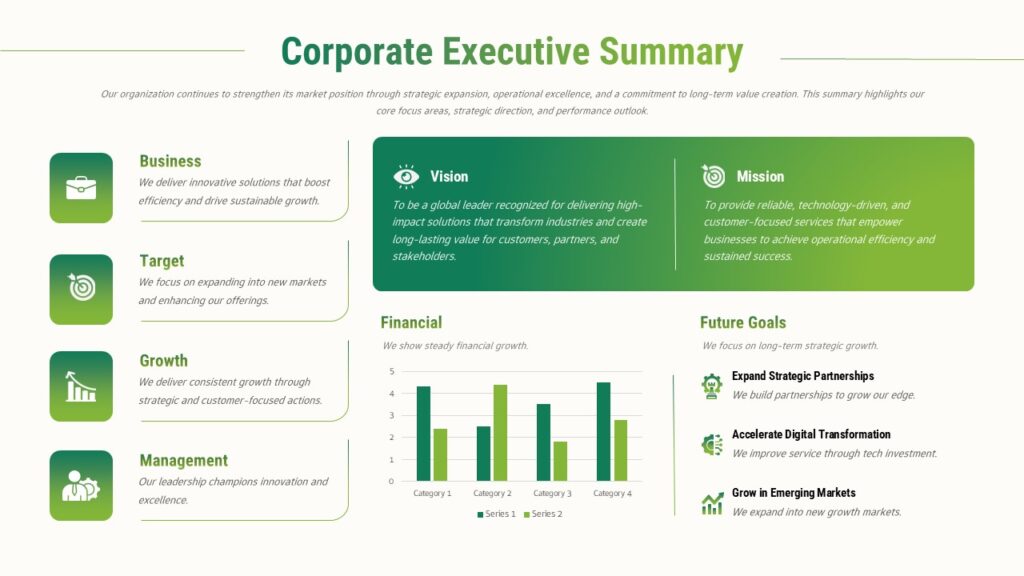
Built for boardroom presentations, investor updates, and leadership reviews. Covers organizational highlights, KPIs, financial performance, and strategic direction on a clean, professional set of slides. Ideal for quarterly and annual reporting.
Executive Summary Dashboard
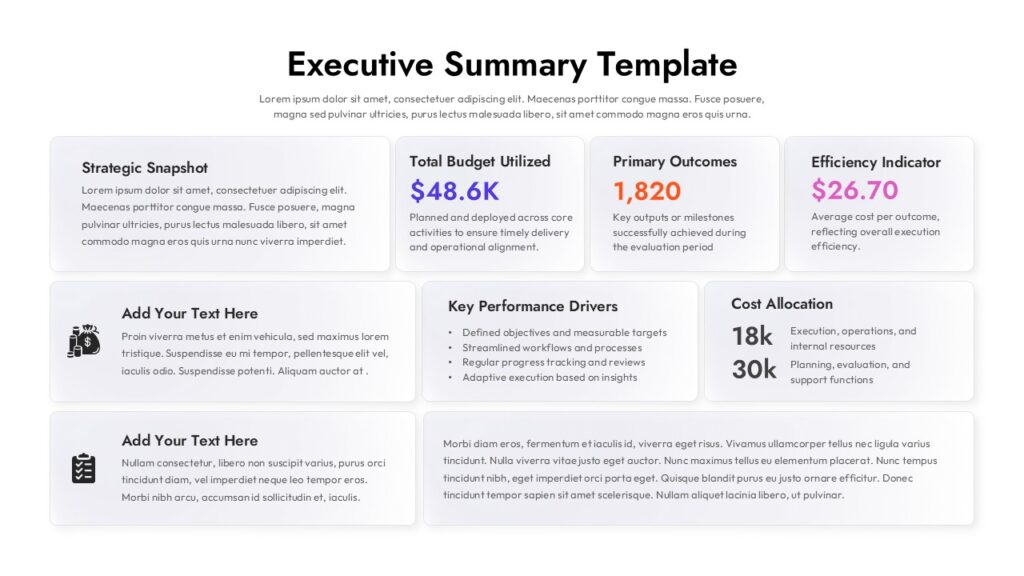
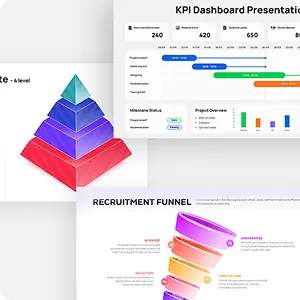
A data forward layout for professionals who need to present metrics and performance snapshots at a glance. Charts, KPIs, and visual indicators are all built in. Perfect for operations reviews and business intelligence updates where numbers need to speak for themselves.
OnePage Executive Summary Layout
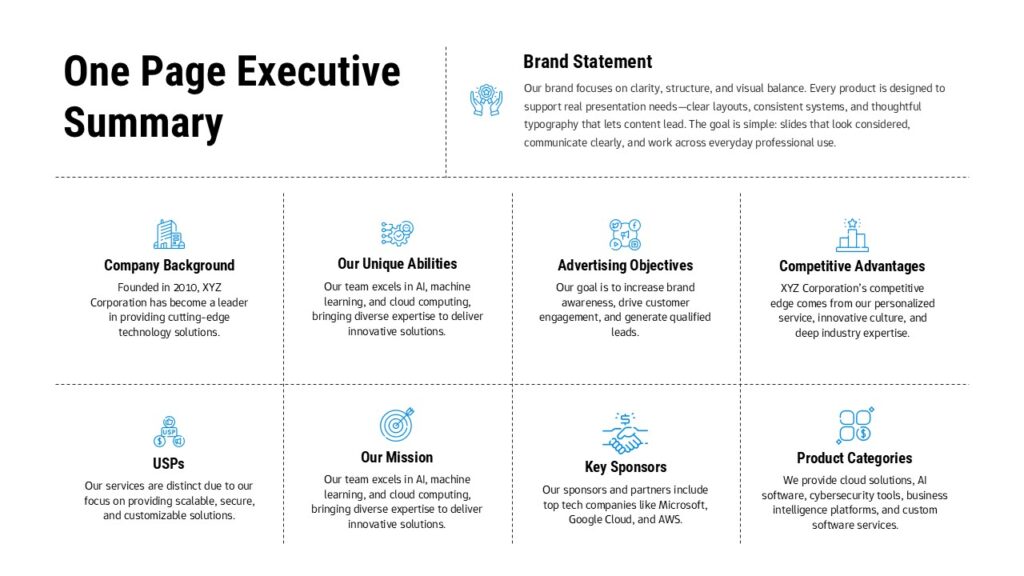
A single, beautifully organized slide that fits everything a decision maker needs situation, solution, results, and ask into one clean view. Great for email attachments, pre meeting documents, and any situation where brevity is non negotiable.
Executive Summary — Business Plan
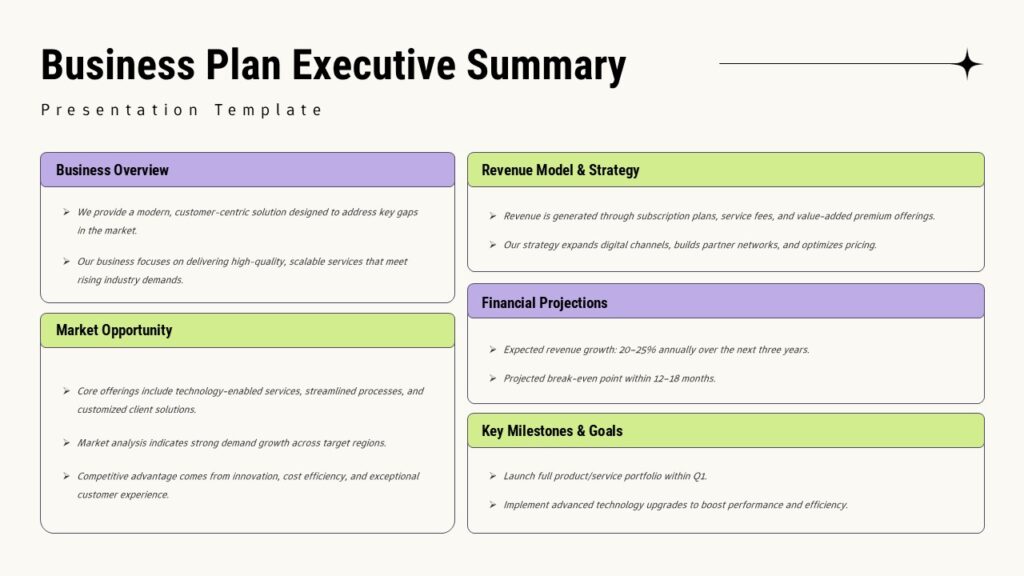
Purpose built for founders and growth teams. Covers market opportunity, value proposition, revenue model, target customers, team credentials, and financial projections. Everything investors expect, already structured and ready to fill in.
Browse the full collection at SlidesDepot to find the format that fits your next document.
Conclusion
Your executive summary is your most important page. It is where you earn attention, establish credibility, and move decision makers to act;before they have read anything else. Understanding how to write an executive summary well is one of the highest leverage communication skills you can develop, because it directly affects whether your proposals get approved, your reports get acted upon, and your pitches get funded.
Lead with impact. Stay concise. Back every claim with data. End with a clear ask. And use a professionally designed template from SlidesDepot to make sure your summary looks as sharp as your thinking.


PowerPoint Shortcuts Every Professional Should Know (And Actually Use)
Creating presentations is a core part of many professional roles, yet countless hours are still lost navigating menus, adjusting layouts, and repeating simple actions. One of the most effective ways to work smarter in Microsoft PowerPoint is by mastering essential keyboard shortcuts. The right PowerPoint shortcuts help you build slides faster, keep designs clean and…
How to Make a Bullet Point on Google Slides (Step-by-Step Guide for Beginners)
If you’re searching for how to make a bullet point on Google Slides, you’re likely trying to organize your presentation in a clearer and more professional way. Bullet points are essential for structuring information, improving readability, and keeping your audience focused. Instead of overwhelming viewers with long paragraphs, bullet points allow you to highlight key…
How to Make Google Slides Vertical (Portrait Mode) – Step-by-Step Guide
Google Slides is one of the most popular presentation tools in the world, but it has one quirk that trips up a lot of users: it defaults to landscape (horizontal) mode. If you’ve ever tried to create a poster, resume, infographic, social media graphic, or flyer in Google Slides and felt frustrated by the horizontal layout, you’re not alone. The…