
What Are the Four Parts of a SWOT Analysis – and Why Each One Matters?


Most business decisions feel harder than they need to be. You have data, opinions, and competing priorities pulling in every direction. A SWOT analysis cuts through that noise by giving your thinking a clear structure. It organizes what you know into four categories, so you can make decisions with confidence rather than guesswork.
Understanding what a SWOT analysis is and how each of its four parts works is one of the most practical skills in strategy. Whether you are planning a product launch, entering a new market, or preparing a quarterly review for leadership, a well-built SWOT frames your position clearly. And when that analysis is presented in a clean, well-structured slide, it lands with far more impact than a paragraph of text ever could.
What is a SWOT analysis?
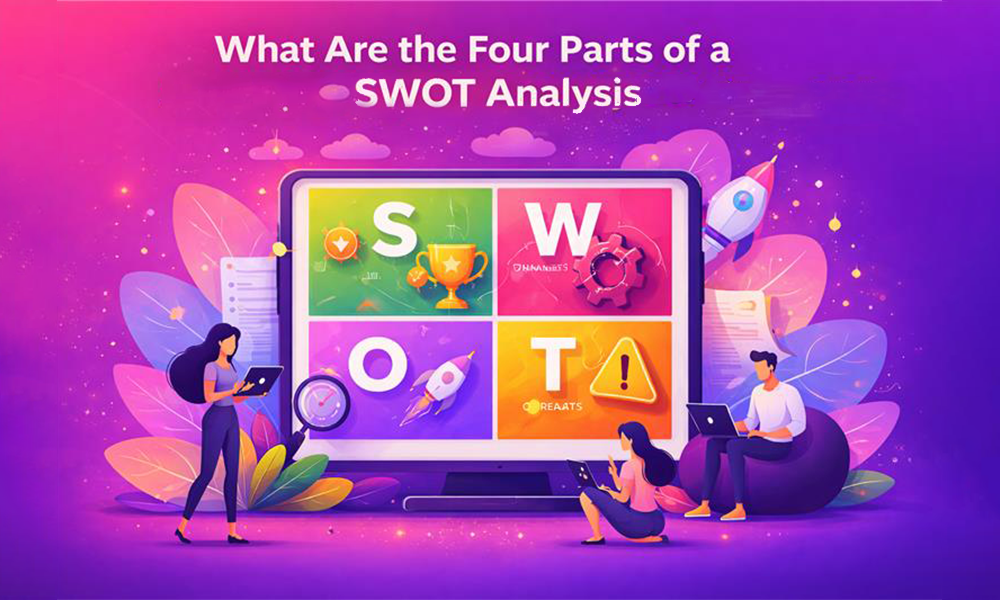
A SWOT analysis is a strategic planning framework used to evaluate a business, project, or decision by examining four key factors: Strengths, Weaknesses, Opportunities, and Threats. The tool was developed in the 1960s at Stanford Research Institute and has remained a cornerstone of business strategy ever since. Its lasting appeal comes from its simplicity. You do not need specialized software or a consultant to run one. You need the right questions and honest answers.
The framework divides your analysis into two dimensions. Strengths and Weaknesses are internal, meaning they reflect factors within your organization that you control. Opportunities and Threats are external, meaning they come from the market, industry, or environment around you. This internal versus external split is what gives the SWOT matrix its structure and makes it so actionable.
Teams use SWOT analysis in business planning, marketing strategy, competitive research, and even personal career development. The format works at every scale, from a solo freelancer evaluating a new service to a global company assessing a new region. If you are presenting the results to stakeholders, using strategy presentation templates from SlidesDepot ensures your findings are communicated with clarity and credibility.
The four parts of a SWOT analysis explained
Strengths

Strengths are the internal advantages that set your organization apart. These are the things you do better than your competitors, the resources you have that others do not, and the qualities that your customers consistently value. Common examples include a recognized brand, a proprietary process, a high-performing team, or a strong customer retention rate.
When identifying strengths, focus on what is genuinely differentiated, not what is simply adequate. Strong presentation design matters here too. If you are mapping your strengths on a slide, use a layout that gives each point visual weight. A cluttered or inconsistently formatted slide undercuts the very strengths you are trying to communicate. business presentation templates from SlidesDepot give you clean layouts and consistent color schemes that keep your content looking sharp.
Weaknesses

Weaknesses are internal limitations that put you at a disadvantage. These might include skill gaps on your team, limited budget, outdated technology, a weak online presence, or high employee turnover. The goal of this quadrant is honest self-assessment, not self-criticism.
The most useful weakness analysis does not just list problems. It prioritizes the gaps that are most likely to affect your goals. If a weakness is minor and unlikely to affect outcomes, it does not belong on your primary SWOT slide. Keep your slide focused on the factors that actually shape your strategy.
Opportunities

Opportunities are external conditions you can leverage to grow or improve your position. These come from outside your organization: shifts in market demand, competitor vulnerabilities, emerging technology, new distribution channels, or regulatory changes that work in your favor.
The key question for this quadrant is: which of your strengths can directly capture these opportunities? That pairing is where strategy gets built. On a slide, opportunities are often most effective when presented alongside the corresponding strength, so your audience can immediately see the connection. Using PowerPoint templates with built-in two-column or quadrant layouts saves you the time of building that structure from scratch.
Threats

Threats are external risks or obstacles that could negatively affect your goals. New competitors entering your market, economic downturns, changing consumer behavior, supply chain instability, and shifting regulations are all common examples. Unlike weaknesses, threats are not within your control. What you control is how you prepare for them.
A strong SWOT does not stop at listing threats. It connects them to your weaknesses so you can see where your greatest vulnerabilities lie. When presenting this to leadership or investors, framing matters. A threat section that reads as a liability list will create anxiety. One that is paired with a mitigation plan creates confidence.
How to turn a SWOT into a real strategy
Identifying the four parts of a SWOT analysis is only the first step. The real value comes from connecting the quadrants to form a strategy. Pair your strengths with your opportunities to find your best growth moves. Pair your weaknesses with your threats to identify where you are most exposed. These pairings are called SO strategies and WT strategies, and they are the bridge between analysis and action.
Keep each quadrant focused. The most effective SWOT matrices contain three to five high-priority items per section, not an exhaustive list. More items dilute the message and make it harder for your audience to know where to focus. When you present a sharp, well-prioritized SWOT in a polished slide, it signals that your thinking is equally disciplined.
If you are conducting this exercise as a team workshop, assign a facilitator, give each participant time to contribute independently before grouping ideas, and then vote on the highest-priority items. This process reduces groupthink and surfaces blind spots that any single person would miss.
Present your SWOT analysis with the right template
Once your analysis is complete, how you present it shapes how it is received. A SWOT that lives in a spreadsheet or a plain document rarely gets the attention it deserves. A well-designed slide, on the other hand, communicates structure at a glance and makes your analysis easier to discuss and act on.
SlidesDepot offers a range of SWOT analysis templates that are professionally designed, fully editable in PowerPoint and Google Slides, and ready to customize with your own content. Each template includes a clean 2×2 matrix layout, consistent color schemes for each quadrant, and space for your key points without crowding the slide.
If your SWOT is part of a larger strategy deck, you can pair it with Google Slides templates that match the same visual style across your full presentation. SlidesDepot also offers pitch deck templates if you are presenting your strategic position to investors or new partners. Having a professionally designed deck removes the friction of formatting and lets you focus on the content that matters.
SWOT Analysis Templates From SlidesDepot
A well-designed slide communicates structure at a glance and makes your analysis easier to discuss and act on. SlidesDepot offers professionally designed templates, fully editable in PowerPoint and Google Slides — here are six options depending on your use case:
1. Marketing Strategy SWOT Designed for marketing teams and campaign planning. Connects internal factors with external market conditions so teams can move from analysis to action quickly. Best for: Campaign planning, brand positioning
2. Personal SWOT Four Column A four-column layout that separates each SWOT component into its own section. Keeps focus on content over visuals. Best for: Career planning, students, personal reflection
3. Vertical SWOT Analysis Arranges all four elements in a vertical sequence where each section builds on the previous one — ideal when you want to guide your audience through the thinking step by step. Best for: Guided presentations, logical walkthroughs
4. 3D SWOT Analysis Uses a 3D-style layout to visually distinguish each quadrant. Keeps information organized while making slides more engaging. Best for: Modern decks, visual presentations
5. SWOT Analysis Quadrant Overview The classic 2×2 matrix. Presents all four components together so internal and external factors can be compared at a glance. Best for: Business strategy, summary slides, formal presentations
6. Clean Minimal SWOT Layout Reduces visual elements so attention stays entirely on the content. The right choice when clarity and simplicity matter most. Best for: Professional reports, corporate presentations
Conclusion
The four parts of a SWOT analysis, Strengths, Weaknesses, Opportunities, and Threats, give you a structured way to understand where your organization stands and what your next move should be. Each quadrant serves a specific purpose, and the real strategic value comes from connecting them. Used well, a SWOT is not a checkbox exercise. It is the foundation of decisions that actually hold up.
Whether you are presenting to a leadership team, preparing for a board review, or building a strategic plan from scratch, the right template makes a real difference in how your work is received. SlidesDepot gives you the tools to present your analysis clearly and professionally every time.
Explore the full SlidesDepot template collection


SlidesCarnival vs SlidesMania: A Complete Guide to Choosing the Best Google Slides Templates for Your Needs
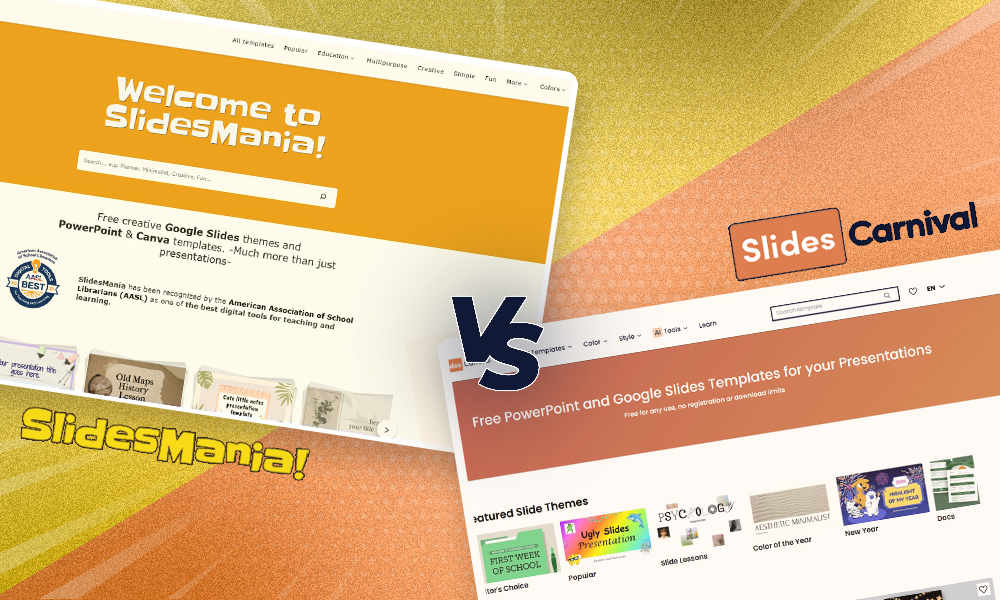
When searching for high-quality Google Slides templates, two platforms consistently stand out: SlidesCarnival and SlidesMania. Both offer free, well-designed presentation themes. Both are widely used. But they serve different audiences and presentation goals. Instead of asking which platform is better, This guide will help you understand their strengths, differences, and ideal use cases so you can confidently choose the option…

Virtual Meeting Etiquette: Do’s and Don’ts for Professional Online Presentations
virtual meeting etiquette are now a daily professional reality. Whether you are presenting a quarterly report, pitching a new client, or leading a team training session, how you show up online shapes how others perceive your competence and credibility. Most people focus entirely on what they will say. They give almost no thought to how…
Understanding Different Types of Graphs: When to Use Each One
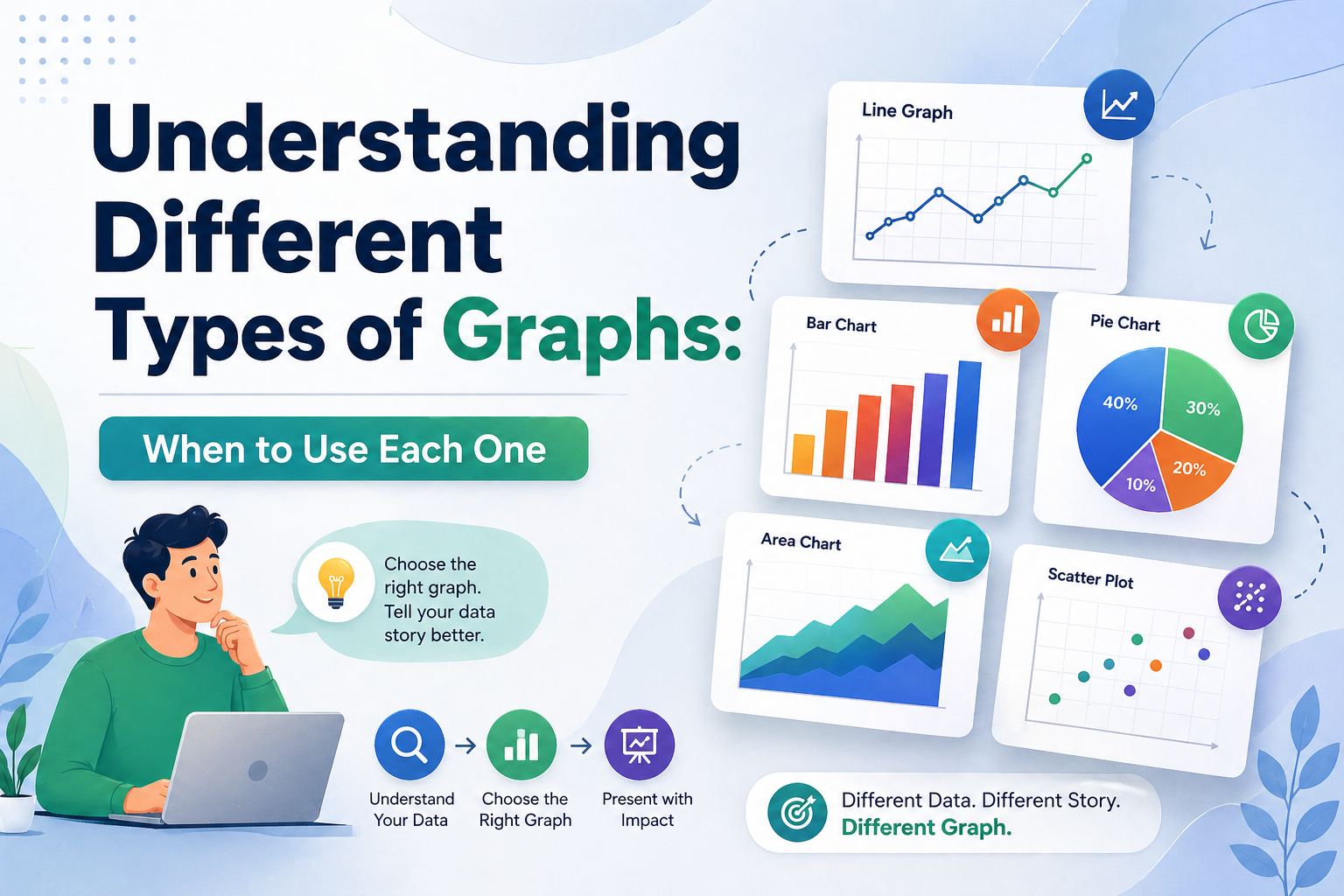
Data without the right visual is just noise. Whether you are a startup founder walking investors through growth projections or a project manager presenting a quarterly sprint review, the types of graphs you choose will determine whether your audience leans in or tunes out entirely. This guide breaks down every major chart and graph type, explains the…