

Six-Step Horizontal Process Diagram Template for PowerPoint & Google Slides
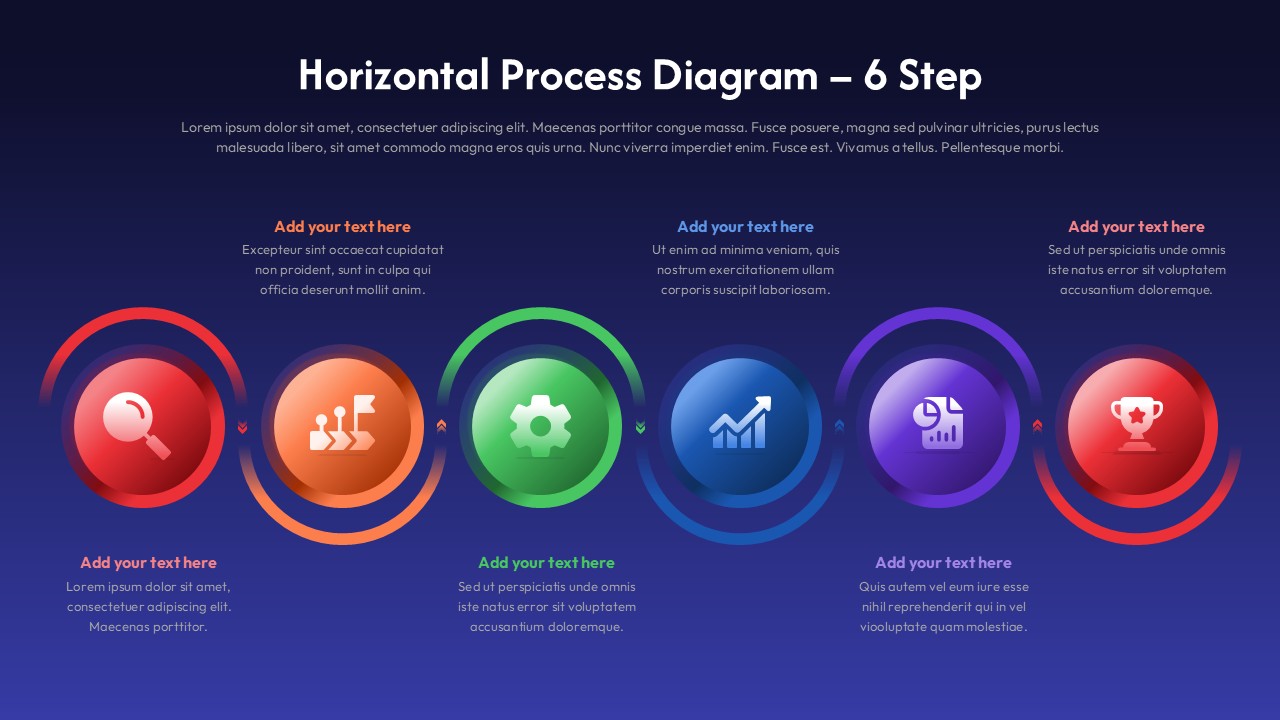
Horizontal 6-Stage Business Process Flow Presentation Template
Sequential processes are genuinely hard to visualize. Not because the content is complicated, but because most slide tools reward people who already know what they’re doing. If you don’t have a solid base to work from, you end up either oversimplifying (a numbered list that bores everyone) or overbuilding (a flowchart that requires a legend).
This horizontal process diagram template is the middle ground that most people spend way too long trying to find themselves.
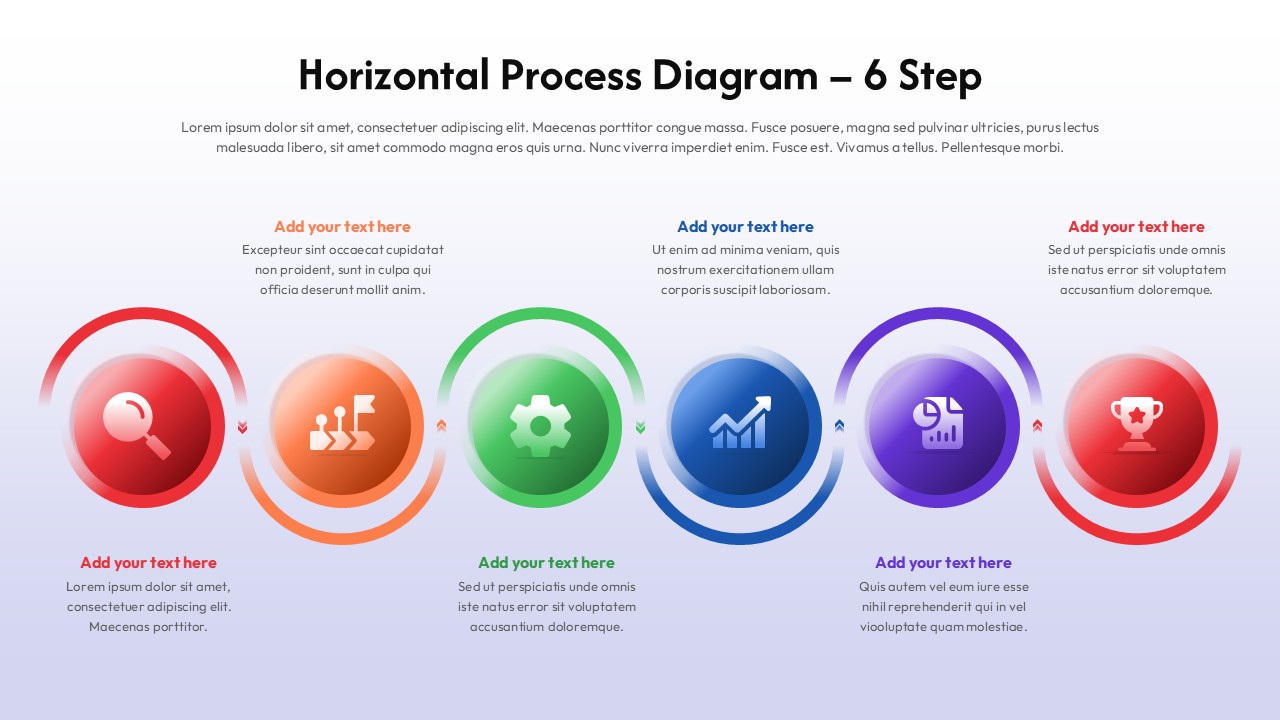
Six stages. Clean horizontal flow. Each step gets a circular gradient icon – moving through red and orange into green, blue, and purple – so your audience can read the progression almost before they’ve consciously processed the slide. That color shift does real work (the kind that usually takes a designer and a conversation about “visual hierarchy” to get right). Here, it’s already done.
Above and below each icon, there’s space for a heading and a short description. That structure forces a useful discipline: you have to be concise, which usually means you end up being clearer. The slides that land well in a boardroom or a training session are rarely the ones with the most on them. The design itself – soft shadows, smooth gradients, directional arrows between stages – sits somewhere between polished and understated. This horizontal process diagram looks like someone made considered choices, which is exactly what you want your audience to think.
Everything is editable. Icons, colors, fonts, the layout itself. If your brand has specific colors, swap them in. If six steps is one too many, adjust it. The point of a well-built template is that it bends without breaking.
This horizontal process diagram works for business analysts walking a client through an operational flow, educators sequencing a lesson framework, consultants presenting a phased engagement model, project managers laying out delivery milestones. The use cases are wide because the underlying need – help people understand what comes next, and why it is nearly universal.
The honest pitch, if there is one: you probably have a process worth presenting. You shouldn’t have to spend three hours building the container for it.
Login to download this file
Template Variations


